
Practical AI solutions for businesses in Erbil
Start with the work your team repeats: sorting inquiries, finding approved information or preparing a first draft. VIST brings creative direction, interface design and scoped software development together to evaluate a useful first workflow for your business in Erbil and the Kurdistan Region. A focused prototype establishes what is worth integrating.
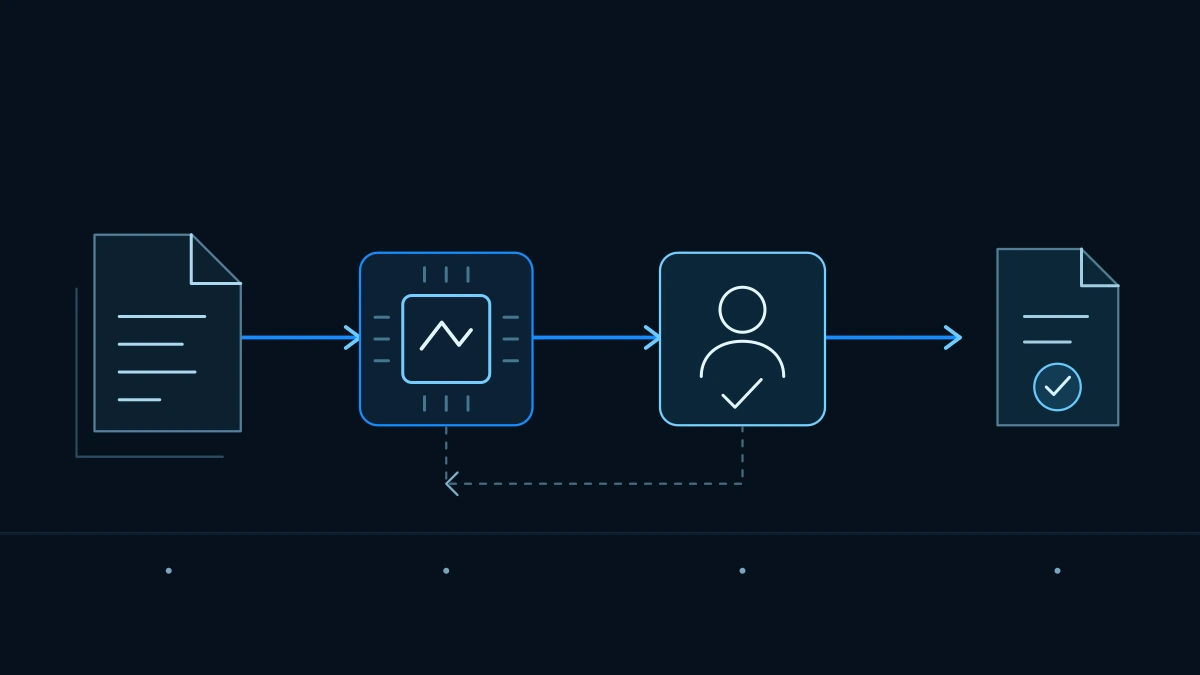
Find the work worth improving
Map where information is copied, searched or sorted, and who handles the exceptions. An inquiry queue, document collection or repeated reporting task may be worth evaluating. A fixed reminder or predictable routing rule may only need conventional automation. We assess the simplest reliable approach before proposing an AI model.
AI-assisted workflows
Possible pilots include classifying inquiries for an employee, organizing documents or drafting an internal summary from approved inputs. Define the input, useful output and failure cases first. Generated summaries and classifications need validation; numerical totals should come from checked calculations. These are possible briefs, not claims of existing client deployments.
Assistants with a defined knowledge boundary
An assistant may help employees find approved company information and prepare a response with source references where available. Agree which documents it can access, how they stay current and what happens when evidence is missing. Retrieval does not guarantee a correct answer. Customer-facing replies and consequential actions require an explicitly agreed review process.
Automation & software integration
Confirm the actual software, available APIs, account ownership and authorized access before choosing an integration. Separate reading information from changing records or sending messages. Use limited permissions, validation and explicit approval for important actions. If AI adds little value, an ordinary workflow or a focused software change may be the better option.
Creative production with AI assistance
Within our creative scope, AI can support concept exploration, organizing research, draft outlines, message variations and production planning. Art direction, factual checks and brand approval stay with people. Source rights and permitted use belong in the brief. Illustrative or generated material must be identified; it must not stand in for authentic client production footage.
A proposed implementation process
Discovery: map one task, users and a baseline. Requirements: agree inputs, data rights and acceptance criteria. Feasibility: compare rules, existing tools and an AI approach. Prototype: use permitted test data with limited access. Validation: record errors, review effort and language-specific results. Deployment: proceed only after acceptance and access approval. Maintenance: agree monitoring, updates, support ownership and recurring costs separately.
Security, failure handling & human authority
Agree data access, retention and provider terms before sharing information. Documents and incoming messages may contain misleading instructions; retrieved text must never grant software permissions. Test incorrect answers, missing sources and failed connections. A reviewer needs a way to reject or correct an output, pause the workflow and return to the manual process. No system is presented as risk-free.
Evaluate each language and its costs
For Sorani, Arabic, English or Persian, test real terminology, mixed scripts, names and common spelling variations separately. English performance does not establish Sorani quality. Identify a competent reviewer for each required language. Compare implementation, data preparation, API usage, hosting, review time and maintenance against the current process. No staffing reduction, saving or fixed launch date is promised.
What can be demonstrated today
Our public portfolio does not yet contain an approved AI automation case study. We can discuss a defined prototype and its acceptance criteria instead of presenting an unrelated project as proof. Explore our software and creative services to understand the adjoining scope; any proposed integration is assessed separately.
Before you commission an AI workflow
Does my business need a chatbot?
Only if a conversational interface addresses a real task. A better search tool, a structured queue or conventional automation may be enough. Begin with the process and compare the options.
Can an assistant use our company documents?
Potentially, subject to ownership, permissions, current source material and technical feasibility. Specify who may see each source, what must be excluded and how answers will be checked. Do not send confidential records with an initial inquiry.
Can a workflow support Sorani and Arabic?
These languages can be evaluated as project requirements. Representative examples and competent language review are essential. Support for a language is not a guarantee of acceptable quality for every task.
Will AI act without an employee?
The first pilot can prepare information while an employee approves the next step. Any later automatic action needs a separate risk, permission and validation decision; autonomous operation is not an assumed deliverable.
What determines the quotation?
The task, permitted data, integrations, languages, testing and handover determine implementation scope. Ask for model/API, hosting, monitoring and maintenance costs separately. A limited prototype may be more appropriate than a new platform.
When should we stop a pilot?
Pause when data rights are unclear, mistakes have unacceptable consequences or the review burden outweighs the benefit. Compare equivalent test cases against the manual baseline and agree stop/go criteria before development.
Bring one workflow to the conversation
- What task is currently manual, and who owns it?
- What information does it use, and who may access it?
- Which languages are required?
- Which existing software systems are involved?
- What outcome should improve, and how will you check it?
A short process description is enough to start. Please do not send confidential customer records, passwords or private documents. Data sharing and permitted test samples are agreed later.